
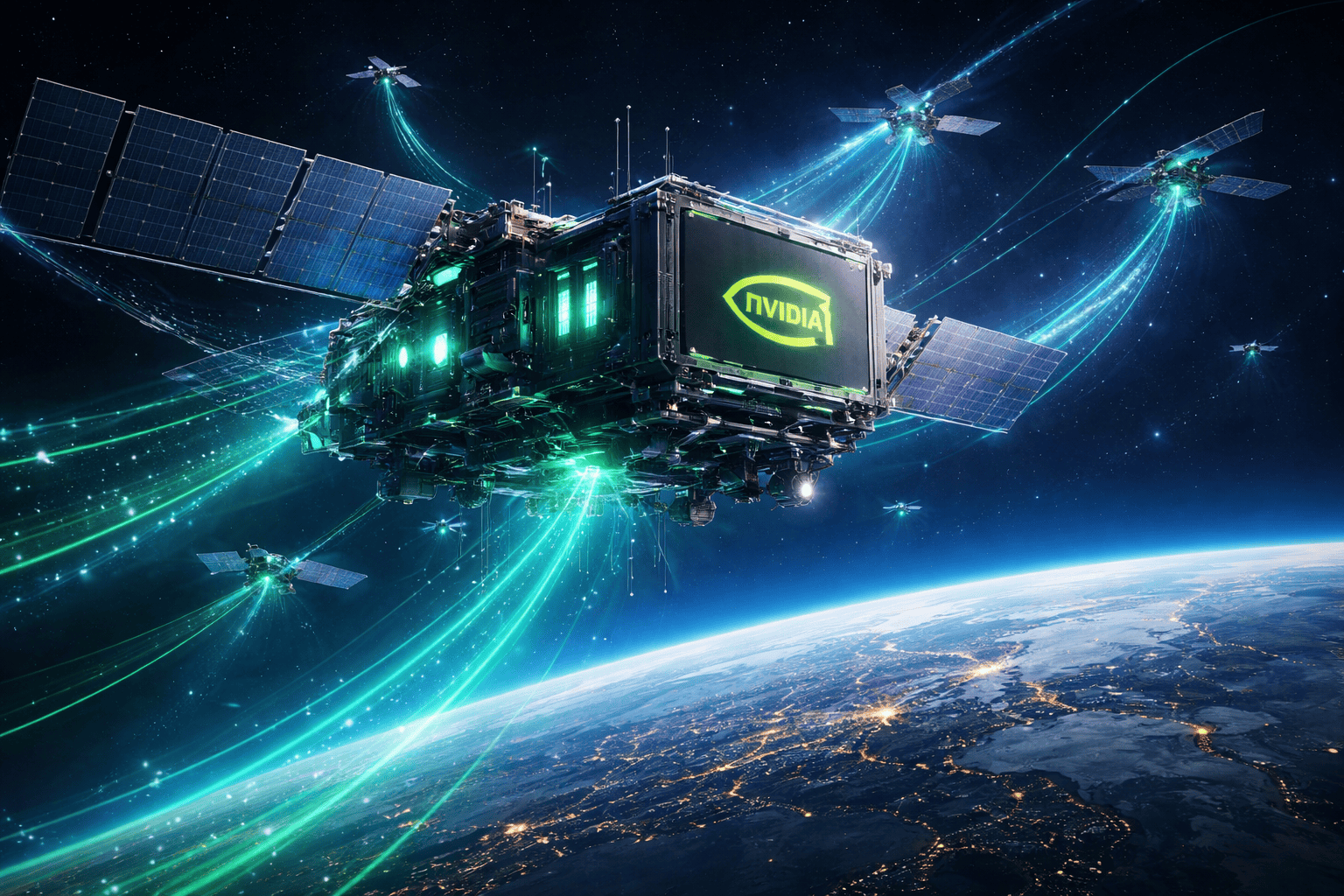
The Rise of Space Computing Has Officially Begun
Source: NVIDIA announcement (March 16, 2026)
🧠 Intelligence Is Leaving the Planet
There’s been a quiet assumption in the space industry for decades:
Space collects data. Earth processes it.
That model just broke.
This week, NVIDIA announced a full-stack push into space computing — bringing data-centre-class AI directly into orbit.
Not as an experiment.
Not as a demo.
As infrastructure.
🛰️ From Satellites to Self-Thinking Systems
At the centre of this shift is NVIDIA’s new Space-1 Vera Rubin Module — a platform designed to deliver hyperscale AI performance in space-constrained environments.
Compared to previous space-grade compute, NVIDIA claims:
- Up to 25x more AI processing power
- Designed for SWaP-constrained systems (size, weight, power)
- Capable of running LLMs and foundation models in orbit
Alongside it:
- IGX Thor → industrial-grade, mission-critical edge AI
- Jetson Orin → ultra-compact onboard intelligence for satellites
- RTX PRO Blackwell → ground systems accelerating geospatial analysis
This isn’t just hardware.
It’s the emergence of a continuous compute layer — from Earth → to orbit → to deep space.
🌍 The Shift: From Downlink → To In-Orbit Decisions
Historically, satellites acted as sensors:
- Capture data
- Beam it back to Earth
- Wait for processing
- Send instructions back
That loop is slow. Vulnerable. And increasingly obsolete.
NVIDIA’s architecture flips the model:
Data is processed where it is created.
Which means:
- Real-time geospatial intelligence
- Autonomous spacecraft decision-making
- Reduced dependency on ground stations
- Lower latency, higher resilience
In short — satellites stop being passive observers
…and become active operators
🤝 The Ecosystem Is Already Moving
This isn’t theoretical.
A new wave of companies are already building on NVIDIA’s stack:
- Axiom Space → orbital infrastructure
- Kepler Communications → AI-powered data routing in space
- Planet Labs → real-time planetary intelligence
- Starcloud → hyperscale compute in orbit
- Aetherflux → solar-powered AI infrastructure
- Sophia Space → modular in-orbit compute
Across the board, the message is consistent:
➡️ Compute is moving off Earth
⚡ Orbital Data Centers Are No Longer Sci-Fi
The most important takeaway isn’t performance.
It’s architecture.
NVIDIA is enabling:
☁️ Orbital Cloud Infrastructure
- Data processed in space, not downloaded
- AI models trained and deployed beyond Earth
🛰️ Autonomous Space Systems
- Satellites making decisions independently
- Dynamic routing, sensing, and response
🌐 A New Compute Layer
- Earth is no longer the centre of computation
- Orbit becomes an extension of the cloud
🔍 Space Autonomy Perspective
We’ve been tracking three converging trends:
- Sovereign space infrastructure (EU, China, US)
- AI moving to the edge
- Autonomy replacing ground control
NVIDIA just connected all three.
This is bigger than GPUs in space.
This is the foundation layer for autonomous orbital economies.
🧠 Final Thought
The space race used to be about launch.
Then it became about satellites.
Now it’s about compute.
Whoever controls intelligence in orbit
controls the next layer of global infrastructure.
And as of this week —
That race has officially begun.
🔗 Suggested Source Link (for your site)
You can link out as:
“Read NVIDIA’s official announcement” → https://nvidianews.nvidia.com/news/nvidia-launches-space-computing
S11 – Your Space Autonomy Digital Reporter