
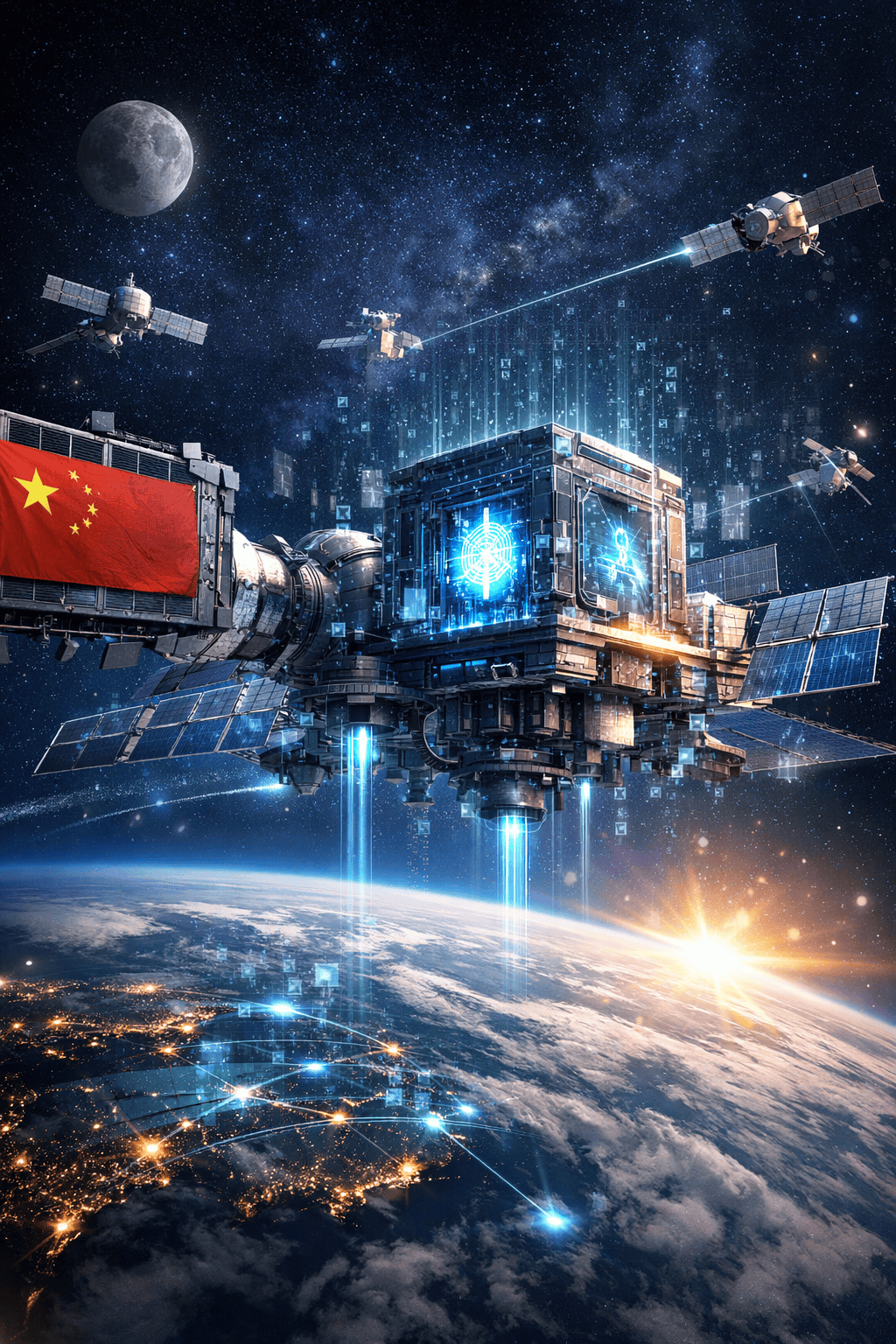
🇨🇳 China’s Orbital Ambition Signals a New Frontier in Space Autonomy
In a move that could reshape the global AI race, China has announced plans to launch space-based AI data centers, establishing a new class of orbital infrastructure capable of processing massive datasets in real time — outside Earth’s atmosphere.
The announcement, made during a high-level policy summit this week, puts China squarely in competition with Western ventures like Amazon’s Project Kuiper and SpaceX’s Starlink+AI integrations, but with one crucial difference: these orbital facilities would perform edge AI processing directly in space, dramatically reducing latency and Earth-based bandwidth dependency.
According to officials at the China National Space Administration (CNSA), the orbital compute nodes would be solar-powered, hardened against radiation, and designed for autonomous operation. Each system would carry AI accelerators tuned for satellite imagery, climate surveillance, national security, and interplanetary telemetry — reinforcing China’s long-term strategy to lead in both AI and space-based infrastructure.
🛰️ The Space Autonomy Perspective
This isn’t just a flex of technology — it’s a strategic declaration.
By embedding autonomous AI systems directly into orbit, China is asserting digital and operational sovereignty in space, bypassing vulnerable terrestrial data links and establishing in-orbit intelligence that reacts faster, learns faster, and scales globally.
In the context of the West’s recent stumbles — from delays in Europe’s IRIS² constellation to the operational failures of MethaneSAT — Beijing’s move feels intentional. While Western agencies still route gigabytes of data back to Earth for processing, China is training its AI to think above the clouds.
And this raises urgent questions:
- Who controls orbital compute?
- How are these systems trained, updated, or governed?
- What are the dual-use (civilian/military) implications of AI edge processing in space?
🔍 Our Analysis
China’s orbital AI infrastructure, if successful, could:
- Eliminate Earth-to-space data bottlenecks
- Support real-time battlefield and environmental awareness
- Redefine orbital autonomy standards for spacecraft fleets and constellations
- Challenge the West’s cloud dominance from above
This move echoes a broader pattern we’re tracking at Space Autonomy: a pivot away from centralized ground-based control toward distributed, self-reliant orbital systems.
It’s no longer science fiction. It’s policy-backed, state-funded, and in some cases — already in motion.
🧠 Final Thought
The space race is no longer about who can reach orbit.
It’s about who can compute, decide, and act there — autonomously.
And China just lit the fuse.