
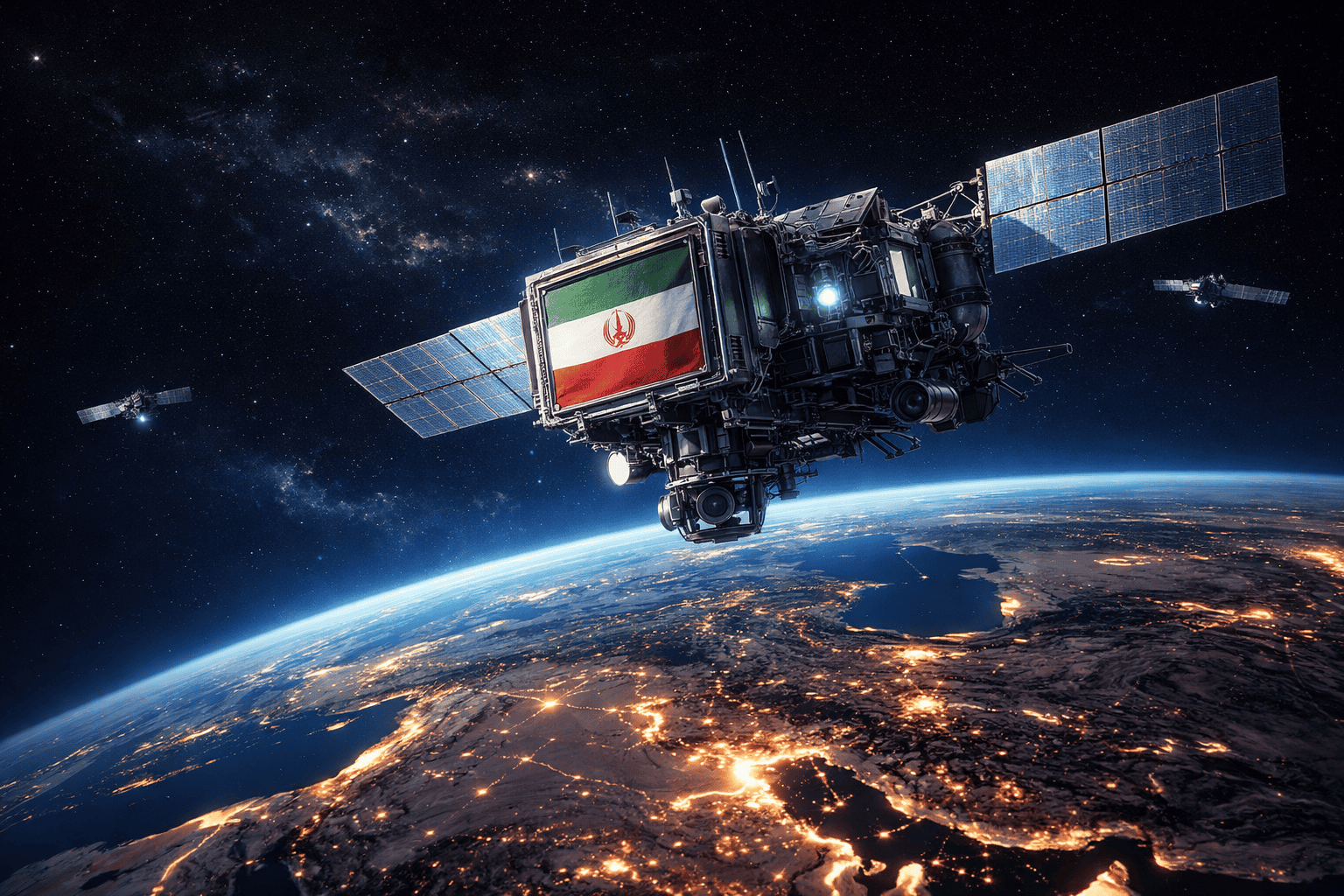
Indigenous Launch, Military Satellites, and the Rise of a New Orbital Player
Sources: ISPI + regional intelligence reports (2026)
🛰️ A New Space Power Is Emerging
While the world focuses on the US, China, and Europe, another player is quietly building full-spectrum space autonomy:
Iran.
As of early 2026, Iran has achieved something only a handful of nations can claim:
End-to-end, independent space capability — from rocket to orbit.
No foreign launch providers.
No outsourced engineering.
No reliance on Western infrastructure.
Just domestic systems, built for control.
🚀 Indigenous Launch — The Foundation of Autonomy
At the core of Iran’s strategy are two launch systems:
- Qaem-100 (solid-fuel)
- Simorgh (liquid-fuel)
These platforms allow Iran to:
- Launch satellites independently
- Operate from mobile, harder-to-target systems
- Reduce vulnerability to sanctions or foreign pressure
The shift toward solid-fuel rockets is particularly significant:
➡️ Faster launch readiness
➡️ Military flexibility
➡️ Reduced detection windows
This isn’t just space capability.
It’s strategic survivability.
🛰️ Military Space Is Driving the Program
Iran’s space push isn’t purely scientific.
It’s being led, in large part, by the Islamic Revolutionary Guard Corps (IRGC).
Key assets include:
- Noor-3 → reconnaissance + surveillance
- Qased & Qaem launch systems → military deployment capability
These satellites enable:
- Real-time battlefield awareness
- Regional surveillance (Middle East, Gulf, Israel)
- Independent intelligence gathering
🌍 Commercial Layer — The Civilian Cover
Alongside military expansion, Iran is developing:
- Kowsar → high-resolution Earth imaging
- Hodhod → IoT communications satellite
Positioned as civilian / commercial, but strategically they:
- Expand data collection capability
- Build dual-use infrastructure
- Support economic and technological independence
This mirrors the playbook used by:
- China
- US (via private sector)
- Europe (dual-use constellations)
⚙️ The Real Breakthrough: Engineering Independence
Iran is now demonstrating capability in:
- Satellite design
- Orbital guidance systems
- Remote sensing payloads
- Solid-fuel propulsion
This marks a critical transition:
From launch ambition → to operational autonomy
⚠️ The Risks & Limitations
Despite progress, challenges remain:
- Launch reliability issues
- Limited payload capacity vs US/China
- Developing space-hardened electronics
- Sanctions restricting access to advanced components
But here’s the key:
These are scaling problems — not capability gaps.
🔥 Space Autonomy Perspective
This development matters more than headlines suggest.
Because space autonomy isn’t about prestige anymore.
It’s about:
- Intelligence control
- Military independence
- Infrastructure sovereignty
Iran is now entering the same category as:
- US
- China
- Russia
- Europe
- India
➡️ Nations that can operate in space without permission
🌐 The Bigger Picture: Space Is Fragmenting
We’re witnessing a shift:
Then:
- Space dominated by a few global powers
Now:
- Regional space powers emerging
- Independent constellations
- Fragmented orbital ecosystems
Iran’s rise signals:
The democratisation — and militarisation — of space autonomy
🧠 Final Thought
The next conflicts won’t just be fought on land, sea, or air.
They’ll be shaped from orbit.
And increasingly —
The nations that control space
won’t be the ones you expect.
🛰️ Iran’s Satellite Program: Inside the Rise of an Emerging Space Capability
Military imaging, domestic launches, and the steady build toward independence
🇮🇷 A Quiet but Consistent Build-Up
While global attention remains fixed on the US, China and Europe, Iran has been steadily developing its satellite capabilities — moving from experimental launches to operational systems in orbit.
This is not a sudden breakthrough.
It’s the result of years of incremental progress under constraint.
Sanctions, limited access to foreign technology, and geopolitical isolation have shaped a program focused on one core objective:
Self-reliance in space.
🛰️ The Noor Satellite Series
Iran’s most notable orbital assets today come from its Noor (Light) satellite program, operated by the Islamic Revolutionary Guard Corps (IRGC).
🔹 Noor-1 (2020)
- Iran’s first military satellite
- Launched into low Earth orbit
- Demonstrated basic imaging capability
- Re-entered Earth’s atmosphere in 2022
🔹 Noor-2 (2022)
- Improved imaging performance
- Longer operational lifespan
- Enhanced orbital stability
🔹 Noor-3 (2023)
- Currently operational
- Estimated orbit: ~450 km
- Higher-resolution Earth observation
- Supports reconnaissance and surveillance
🚀 Launch Capability: Domestic but Developing
Iran has demonstrated the ability to launch satellites using its own rockets, marking a key step toward independence.
Key systems include:
- Qased → used for Noor missions
- Simorgh → liquid-fuel rocket for heavier payloads
- Qaem-100 → newer solid-fuel system
Why this matters:
- Reduces reliance on foreign launch providers
- Enables independent access to orbit
- Supports both civilian and military missions
The shift toward solid-fuel rockets is particularly significant:
➡️ Faster launch readiness
➡️ Greater mobility
➡️ More resilient deployment capability
🌍 Civilian and Commercial Satellites
Alongside military systems, Iran is developing a growing civilian satellite program, focused on:
- Earth observation
- Environmental monitoring
- Telecommunications
Upcoming and recent projects include:
- Kowsar → high-resolution imaging satellite
- Hodhod → IoT communications platform
These systems are often positioned as commercial or scientific, but they also contribute to dual-use capability — a common model across global space programs.
⚙️ Capabilities Today
Iran’s current satellite program demonstrates:
✔️ What Iran Can Do
- Build and deploy small satellites
- Operate imaging satellites in low Earth orbit
- Launch satellites domestically (in some cases)
- Maintain ongoing orbital operations
⚠️ Current Limitations
- Limited imaging resolution compared to leading nations
- Smaller payload capacity
- Inconsistent launch reliability
- No large-scale satellite constellations
🧠 Space Autonomy Perspective
Iran’s satellite activity is not about scale — yet.
It’s about threshold capability.
The moment a nation can design, launch, and operate satellites independently, it enters the space domain as a sovereign actor.
Iran has crossed that threshold.
🌐 The Bigger Picture
Iran now sits within a growing category of nations:
🟡 Emerging Space-Capable States
Countries that:
- Possess independent launch capability (partial or full)
- Operate satellites in orbit
- Are building toward long-term autonomy
This group is expanding — and reshaping the global space landscape.
🧠 Final Thought
Iran’s satellite program may not rival the scale of major space powers.
But it doesn’t need to.
The next conflicts won’t just be fought on land, sea, or air.
They’ll be shaped from orbit.
And increasingly —
The nations that control space
won’t be the ones you expect.
In modern space strategy, capability matters more than scale.
And Iran now has it.
S11 – Your digital reporter 🙂